
Article Summary: Museum fatigue illustrates how sustained mental effort leads to cognitive exhaustion, a phenomenon also common in high-stakes healthcare settings. Emerging research challenges older theories of mental fatigue, pointing instead to the buildup of glutamate in the prefrontal cortex during intense thinking. Although glutamate supports learning and memory, excess levels impair decision-making. Rest and sleep restore balance, suggesting cognitive fatigue serves as a biological warning to pause and recover.
Ever been to a museum of one sort or another, and within 30 minutes or less, you are feeling mentally worn out, even sleepy, despite ostensibly being enthusiastic for the visit and well-rested? The phenomenon of museum fatigue is the real deal, first described in 1916 by Benjamin Gilman, then curator of the Boston Museum of Fine Arts. Using scientific methods, he revealed what amounts to progressive brain fatigue among museum-goers, as the cognitive strain of viewing and contemplating an unending number of items on display takes a toll. Interestingly, a visit to the zoo can have the same effect!
The same museum, 60 years later, adopted an Occam’s Razor approach to this type of metal fatigue, actively encouraging visitors to participate in its “Please Be Seated” campaign. Signage throughout the museum urged visitors to have a seat on the many strategically positioned benches. Contemporary strategies include incorporating cafes and gift shops within the museum’s footprint, utilizing creative lighting, employing concise language in posted exhibit descriptions, and even selecting wall colors that visually stimulate rather than calm visitors.
Cognitive fatigue: Allied but different from museum fatigue
While we will focus on the cognitive, or mental, fatigue a CRNA might experience during patient care activities, we should also note the potential for anesthesia administration to impair long-term cognition in those who entrust us with their care. Abundant evidence reveals an association between surgery under general anesthesia and subsequent short- and long-term cognitive function in a subset of patients. Debate abounds over whether this is attributable to the drugs we use, to other patient- and procedure-specific factors, or to a complex interaction. Interestingly, regional anesthesia may not be devoid of cognitive effects.
We’re all familiar with cognitive fatigue, because we’ve likely experienced it at some point, given the complex, high-pressure, and stressful nature of anesthesia care. It is a well-described phenomenon. We also recognize that a demonstrable limitation of the human brain, rendering it inferior to computers, is its susceptibility to fatigue.
We totally get the basis of exercise fatigue. Depletion of substrates, accumulation of lactic acid and reactive oxygen species, electrolyte imbalance, and dehydration all contribute. Sleep, essential to life, remains one of the mysteries of our physiology, and currently, no definitive comprehensive explanation exists, though theories abound. But quite apart from these is cognitive fatigue, a phenomenon that has long intrigued and baffled us. Why should thinking be fatiguing or exhausting? Does the brain wear out?
Theories behind mental fatigue
A new paper in Trends in Cognitive Sciences challenges the two prevailing theories of cognitive fatigue. One suggests it is due to a depletion of substrates, like glucose and ketone bodies. The second describes it as a trick the brain uses to distract us from an uncomfortable or demanding mental task. Think of it this way: you are working through yet another online course to maintain credentialing at your facility. It feels mentally exhausting. But suddenly enlivening you is stopping that onerous task and getting on with something like streaming a movie you’ve wanted to see, or heading out with friends to play volleyball, maybe going out to eat, taking a bike ride, or even going shopping! Is the brain sending distracting signals that it is time to play and not work? What is going on here, and what is the actual mechanism of cognitive fatigue?
The lead investigator of the new paper, Mathias Pessiglione, noted that when we are cognitively tasked, there is often a preference for “low-cost” options that provide the opportunity to experience a reward with very low associated cognitive effort. His team, using sophisticated methods, suggests that there is a functional alteration in the brain substance itself due to the accumulation of noxious compounds. As these compounds accumulate, the brain signals us to moderate, or even cease, intense cognitive activity.
Understanding the brain’s biochemistry
We are aware of the overwhelming superiority of machine problem-solving in terms of speed, stamina, and resistance to distraction compared to that of humans. Shedding light on the brain’s stamina and how understanding its biochemistry might explain cognitive fatigue necessitated that Pessiglione’s team use sophisticated tools. These included magnetic resonance imaging (MRI), pupil dilation (pupillometry), and magnetic resonance spectroscopy (MRS). They endeavored to avoid the pitfalls of self-reported fatigue measured with a visual analogue scale, as mental fatigue can easily be confused with other states such as demotivation, frustration, boredom, and sleepiness. Using techniques like MRI and MRS provides a real-time, quantitative assessment of brain biochemistry.
Let’s get to what the researchers found. After assigning subjects to perform tasks requiring either intense mental effort or relatively easy ones, all were observed for a day. High levels of a neurotransmitter were found in those performing the more challenging mental tasks, along with indicators of cognitive fatigue, suggesting that an accumulating metabolic burden may play a role.
Many subjects in the high-intensity mental task group experienced significant pupil constriction, and they opted to engage in activities that provided immediate gratification to relieve their cognitive fatigue. The low-intensity group did not experience these phenomena. While the brain neurotransmitter level in the first group was very high, it was low in the second, low-intensity group, which did not experience what we might refer to as “burnout.” Pessiligone’s team reported that the concentration of a key neurotransmitter in the prefrontal cortex increased with intense mental tasking and was strongly associated with resulting mental fatigue.
They further surmised that, like our muscles, the brain needs a break during or after intense thinking. And what is the toxic metabolite that appears to be the culprit? It’s glutamate, and Pessiglione’s team suggests the brain needs time to clear itself of the compound.
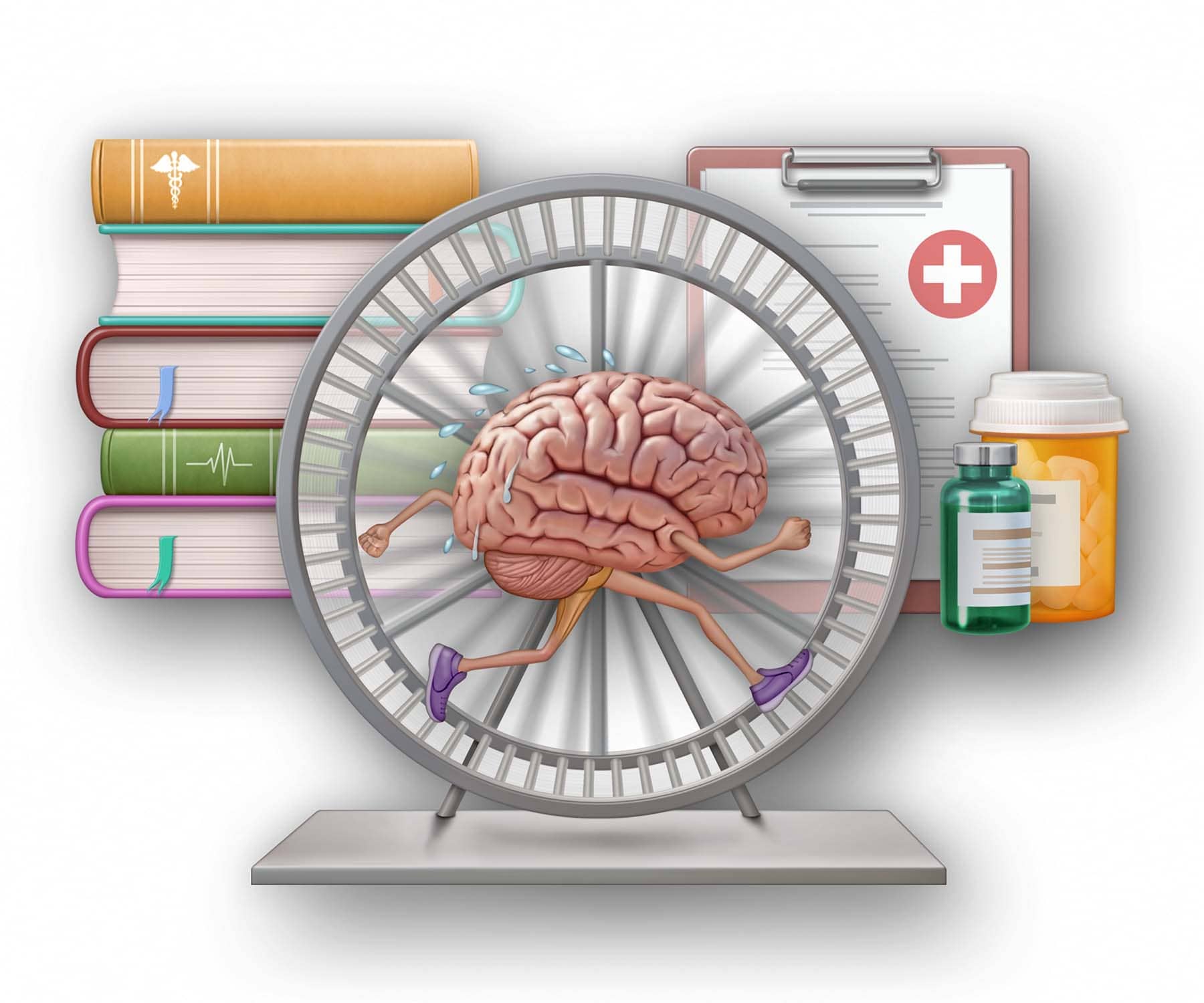
What is glutamate, and what does it do?
In caring for patients, CRNAs become the caretakers of the patient’s neurotransmitters. Think of drugs that work on the GABA receptor, causing neuroinhibition in the brain. Contrast that with its competitor, glutamate, our major excitatory neurotransmitter in the brain. The intricate balance of these molecules and others optimizes human performance throughout the day. Glutamate, an amino acid, is essential for forming memories, regulating mood, and cognitive processing of information. But its excessive accumulation has been shown to be toxic in previous studies.
Pessigliome’s team contributes to our understanding of learning, thinking, and why our brains may “tire,” offering some intriguing insights and speculations about how we might avoid mental fatigue. There is even the possibility that the cognitive fatigue arising from glutamate accumulation in the prefrontal cortex might help prevent burnout, acting as an early warning system to seek relief before it becomes irreconcilable.
Glutamate is metabolized, and its levels in the brain’s synapses return to normal with rest, a relaxing or fun activity, or sleep. Accumulated glutamate might impair our decision-making when it reaches the level of mental fatigue. It seems reasonable that when we are offered a short break or a lunch/dinner break at work, we should take advantage of that downtime to truly relax as much as possible and avoid imposing mentally challenging activities on ourselves.
The researchers did not suggest pharmacologically counteracting the cognitive fatigue that may be induced by rising glutamate levels, which their study did not explore. What they did was advise rest and sleep. Their next step in the research process is to delineate how age, comorbidities, nutrition, sex, and circadian factors might serve as risk factors for glutamate concentration in the prefrontal cortex.
Good science can address important questions in meaningful ways. Likewise, it can generate questions that need answers! Pessigliome’s study does both. While identifying the role of glutamate in producing cognitive fatigue, other compelling questions emerged. Consider a few of them:
- Are there common metabolic denominators among physical fatigue, chronic fatigue, and cognitive fatigue?
- Can the brain, like a muscle, be “trained” to make it less vulnerable to fatigue?
- Are there ways to accelerate recovery from cognitive fatigue?
- What factors, genetic or otherwise, make some of us more resistant to cognitive fatigue than others?
- What are the best tools, at home or work, to measure cognitive fatigue?
There’s much to consider about cognitive fatigue and the monster it can become when intense thinking is essential. While we are not suggesting you take this one to your employer, there is a growing body of literature about the value of “napping rooms” for healthcare personnel working long shifts. At least for now, take a break and give your brain some rest!
We understand the challenge of finding and earning CRNA CE credits while also maintaining a busy schedule. Whenever you’re ready, we have a course that fits what you need to meet the NBCRNA MAC program requirements.
Related Articles