Key Takeaway: Stress runs deep in daily CRNA clinical practice. Long, unpredictable hours, high-stakes decisions, and a culture demanding error-free care leaves anesthesia providers facing elevated rates of anxiety and burnout. Though many in the field often cope alone, there are confidential resources available to SRNAs and CRNAs, including the AANA Helpline and Crisis Lifeline.
Whether you took the National Certification Examination (NCE) recently or some distant time ago, you likely recall the tension involved, given that it was a high-stakes event. Your education and training secured you the opportunity to sit for the NCE. It represented the final summit to conquer, with nationalized credentialing allowing you to practice the art and science of anesthesiology.
It’s interesting to talk to folks, as we have many times, in the aftermath of taking the NCE, and query them about their report of anxiety during the exam. As you can likely surmise, a plot of responses from those who passed and those who failed reveals a wide range of psychological states varying from poise and equanimity to on-the-spot decompensation. Not captured, but what may underlie some level of anxiety is how some of us process an exam, that is, neurodivergence.
We have an acquaintance who recently took and passed a very difficult exam, the Certified Public Accountant (CPA) exam. His experience (self-report of an 8 on a 0-10 visual analog scale with 10 representing “incapacitating anxiety”) led us to do a little research about the exam that he took. Here are a few takeaways, all from peer-reviewed sources:
- 40-80% of CPA exam takers may suffer from performance-degrading anxiety.
- Significant to severe physical and mental fatigue is often self-reported.
- Because the CPA exam is high-stakes, time-limited, very expensive, and often administered in a confined, intensely monitored, sterile, and secure testing location, all of these factors may conspire to amplify the trepidation experienced.
- The extensive volume of material that the candidate is tested on is greatly concerning.
- It is not uncommon for test takers to experience brain fog, mood swings, self-doubt, and even trash-talking themselves during the exam.
- The anxiety continues after the exam as the final report often takes weeks.
While we are not suggesting a one-to-one comparison, it is interesting that other professions requiring pre-practice certification, such as law, engineering, and medicine (USMLE or COMLEX-USA), report similar or even higher levels of anxiety. All share common ground in exam difficulty, importance, cost, and associated stress.
Shifting gears: Clinical anxiety vs test-taking anxiety
While the NCE can trigger some serious catecholamine release in some, what about clinically care-related anxiety? How common and how intense is anxiety during clinical care among CRNAs and physician anesthesiologists? Like anger, frustration, joy, irritation, and even love, anxiety is an emotion variably experienced by all humans and sometimes unexpectedly triggered.
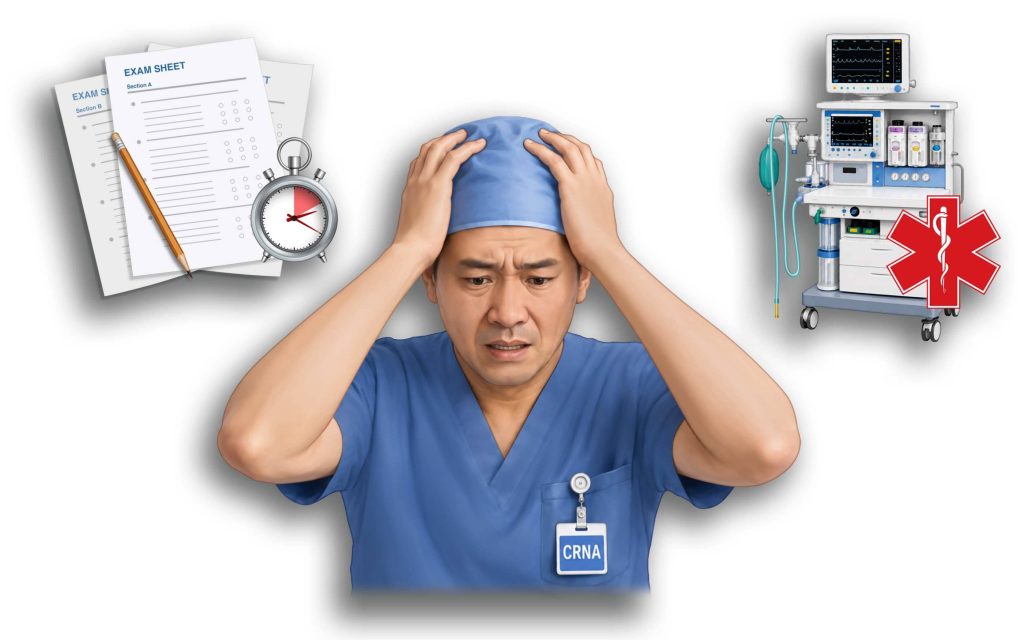
CRNAs work in a very intense and stressful setting, and anxiety may be variably experienced and managed, again with that bell-curve in mind. This is especially the case when a threatening clinical “situation” develops, or just from the day-to-day demands that characterize our work life. The wellness movement promoted by the AANA and many other professional healthcare societies has shed light on what, for many years, was poorly illuminated. That previously darkened terrain has proven somewhat unsettling in what is revealed.
Our work environment can impose significant stressors that we may respond to maladaptively. Any of these, independently or in concert with one another, may jeopardize our mental health; among these are:
- Long, sometimes unpredictable hours during which we are exposed to intense and high-stakes decision-making.
- Complications of all kinds, including patient death, may occur, even in the most straightforward case.
- The demand for absolute perfection is ubiquitous; any deviation from error-free care is not well tolerated.
- Errors and misadventures, when they do occur, are often managed in a vacuum by the provider, as our culture generally discourages admission of weakness and may not offer mental health services.
There’s good evidence that anxiety, depression, burnout, alcohol and other substance abuse, depression, physical infirmity, and even self-harm are all heightened and occur at a higher rate among anesthesia providers than is seen in the general population. We are not trying to draw parallels, make predictions, or assert any form of association between test-taking anxiety and clinical anxiety. Rather, we intend to describe that anxiety and the challenges in dealing with it are real. We are educated and trained, and work in a complex and very demanding field.
Seeking help as a student, trainee, novice, or veteran CRNA
Without hyperbole, we want to acknowledge, even within the circle of SRNA and CRNA providers whom we have known personally, several examples of those who suffered, or are suffering, significant to severe mental health struggles. At least three, and possibly another, ended catastrophically, sending reverberations through the departments they worked in and, poignantly, their families. In those cases, colleagues, friends, and family members were left wondering whether they might somehow have intervened. An inescapably dark void many still live with.
The stress of being a trainee, a provider, or a teacher/preceptor can be, like all human experiences, assessed on a continuum like that bell-shaped curve we mentioned earlier. Whether student or fully credentialed provider, take care of yourself, be aware that any of us might be at risk for a mental health break under the right circumstances. When you can, offer a thoughtful and kind heart to a colleague among you who may be hurting.
Below are a few resources for you to be aware of, and should the issue manifest in a colleague, perhaps pass them along. What a great privilege it is to do what we do, to have a patient put their absolute trust in our hands, often at what may be the singularly most distressing time in their life. Honor that privilege by helping to ensure you are the best that you can be for them. Our job is far more than just excellent technical skills and in-depth knowledge.
Helpful resources for SRNAs and CRNAs that are confidential and free:
- AANA Helpline, 800-653-5167
- Suicide and Crisis Lifeline, 988
- Crisis Line Counselor, Text HOME or HOLA to 741741
We understand the challenge of finding and earning CRNA Class A credits while also maintaining a busy schedule. Whenever you’re ready, we have a course that fits what you need to meet the NBCRNA MAC program requirements.
Related Articles