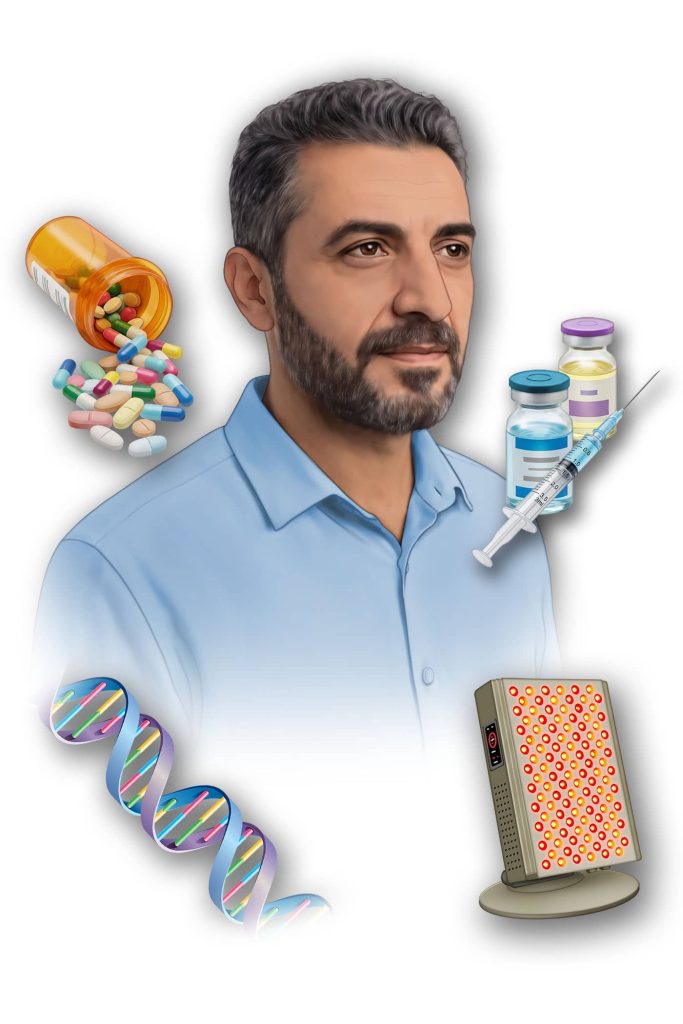
An “enhanced posthuman” may be coming—or may have already arrived—to an OR near you! We are going straight to what drives the biohacking movement by quoting one of its most zealous advocates, who recently went public with:
“I think that what we are doing with biohacking is the beginning of humanity’s split into different species. Enhanced posthumans who will not look anything like today’s humans. I want there to be a great future for those of us who want to become posthumans. I want to encourage all humans to explore ways to enhance their health, intelligence, and productivity. There is a real risk of being left behind if you do not do that.”
This comes from a social influencer who, at a healthy and youthful age of 30-something, was spending well over $200,000 a year on supplements, injectables, tests, devices, and strategies to ward off aging, with over $1.5 million invested so far. A Silicon Valley disciple, he embarked on a quest to “enhance” and become, in his own words, “posthuman.”
Biohackers are likely already among our patients. A CRNA’s caseload over time is a reasonable sample of the general population, much like the shoppers at a Target, the patrons of a city library, or the line at the local post office. Just as we increasingly care for patients who use GLP-1 agonists, vape, take psychotherapeutic medications, or are over 100 years old, we may well encounter biohackers in our everyday practice. To care for them well, we first need a clear sense of what biohacking actually is.
Biohacking: It’s fundamentally about “self-enhancement”
Biohacking, as a distinct movement, is relatively new and evolving, with varying degrees of pursuit and commitment. The movement is evolving as it rapidly transitions from a rational, safe approach involving exercise and lifestyle interventions to what is arguably a risky and unconventional enterprise as it ascends a metaphorical ladder of complexity.
At the bottom rungs of our ladder, we see biohacking as making changes to improve your overall well-being, with low-risk pursuits like adopting a healthy diet, getting adequate exercise, managing stress, and ensuring adequate sleep. We would also include intermittent fasting as a “lower rung” pursuit.
But as we ascend the higher rungs of the ladder, we encounter interventions that involve injecting self-compounded agents or inserting devices into the body; “do it yourself” (DiY) is a foundational theme. There are even descriptions of kits that can be obtained to alter your fundamental genetic material. The goal is often very specific, like improving intelligence, decreasing body weight, enhancing reaction time, coping with anxiety, gaining muscle strength, and, growing in popularity, increasing normal lifespan by decades.
We want to clarify that while plastic surgery, use of Botox, or any number of other aesthetic approaches might fit our definition of biohacking, we are not going to discuss those here. Instead, let’s focus on interventions and procedures that target the body from much higher rungs on the ladder. These involve purposefully manipulating our innate biology.
Just how far will a DiY biohacker go in pursuing the “posthuman” movement?
Extreme biohacking?
We came across several remarkable cases of biohacking, including some involving people who spent a great deal of money pursuing it. But let’s look at a couple of enhancements that are complex and notably risky. In doing so, meet Josiah Zayner, a previous NASA biochemist with advanced degrees in molecular biology and biophysics. Zayner has strong, highly favorable views on biohacking, which he enthusiastically espouses as a social influencer. He includes examples of self-experimentation he has conducted in his advocacy.
You may recall reading or hearing about CRISPR, a procedure used like a molecular scissor and stapler to excise, add, or otherwise edit genetic material at targeted places in one’s genome. A 2020 Nobel Prize in Chemistry was awarded to its two discoverers. Zayner, experienced with the technique, performed a fecal microbiota transplant using a donor sample in an attempt to replace his entire microbiome with the donor’s, and later injected CRISPR-modified DNA into his arm to genetically alter his body habitus. All served as part of his social influencer role and the promotion of DiY biohacking. His “success” in altering his DNA is documented in a short documentary film fittingly called “Gut Hack.” It’s available on Netflix for those of you who subscribe. More recently, he expressed regret for doing so.
Interest in DiY biohacking is growing among an expanding legion of devotees in the general population. This spans the spectrum from high school students who have bioengineered bacteria at local science fairs to proponents of self-injections of home-brewed genetic therapies used to grow bigger muscles or to remedy a viral infection. To develop the skill and confidence in performing DiY genetic modifications, you can purchase online kits like the Green Tree Frog Gene Therapy Kit© that comes fully outfitted (frogs included!) and instructs you step-by-step to genetically modify frogs in your kitchen, basement, garage, or wherever you choose. Current pricing as of this writing is $ 1,999.00. A recently discounted version, including six frogs, will arrive at the purchaser’s door for $499.00. What better way to gain experience so that you can engage in some serious self-biohacking than to practice on frogs!!
The frog approach to biohacking may soon be disappearing from the marketplace, but fear not, the online availability of live biohacking remains alive with new products to develop your skills on emerging every day. This is not an industry in danger of devolving!
While biohacking takes many forms, it is clear that an increasing number of folks are actively exploring its possibilities or performing interventions on themselves. As with so many human enterprises, this represents yet another use of biotechnology to change life; the only prerequisites seem to be an internet connection and some cash.
The pervasiveness of DiY biology
A little over a decade ago, a founding organization dedicated to establishing a nationwide network of DiY auto-bioengineering was established, resulting in a proliferation of followers and communal or personal home labs throughout the U.S. Its stated mission is to advance the power of biotechnology and understand its potential in the hands of all citizens. On its home screen, it describes itself as “An institution for the DiY biologist.” It has followers throughout the U.S., and the platform notes representation from over 150 countries.
Some final random thoughts
In our research on self-administered biohacking, we encountered a diverse range of agents, techniques, and procedures, almost all of which are unregulated and unconventional. From what we observed, there is a strong inverse relationship between the degree of unconventionality of what is being done and the amount of peer-reviewed scientific evidence supporting it.
What are the risks?
The greatest concerns are that unconventional enhancements often involve poorly studied materials that are introduced into the body, and that some procedures involve purported gene editing. These enhancements are often developed and tested in a communal or personal home lab and may be promoted by anecdote as the primary, if not sole, source of evidence.
The lack of regulation of any sort—a mantra of the movement, in which freedom to pursue enhancement is espoused as a right, independent of traditional medical oversight—creates uncertainty about short- and long-term consequences. For example, while there is ongoing progress in mainstream gene therapy targeting specific genetic conditions, DiY biotechnology to genetically enhance normal physiological function using untested and potentially risky concoctions brewed at home is concerning.
What are we to make of it all?
We do not wish to denigrate or suggest there is no role for this kind of open-science, communal movement. It exemplifies an ethos that rejects corporate privatization (e.g., anti-Big Pharma) and the overreliance on costly prescription drugs and traditional, medically directed interventions. Open science favors self-exploration, the sharing of knowledge, and avoiding being held hostage by unnecessarily restrictive governmental regulation. It may even identify or speed new advances in healthcare. We totally get the point.
The DiY biology and biohacking movement is a joint open-science and open-social movement. Through the lens of its most transparent promotional organizations, such as the Biohacking Village, the goals are to pioneer new cures for diseases, eliminate conditions such as HIV and herpes, and optimize human performance. The caveat is that these goals are pursued outside the expensive, time-consuming, and heavily regulated boundaries of traditional academic and governmental science approaches.
We want people to be well-informed about the choices they make and what the risks are of those decisions. As specialists administering complex drugs and performing invasive procedures, each with significant risk profiles, CRNAs know that adding uncertainty to the mix can threaten patient safety. A biohacked patient may respond differently to our care, harboring unknown and perhaps unknowable risk. We will continue to keep you aware of what’s going on “out there,” including the unknowns inherent in caring for “posthuman” patients!
We understand the challenge of finding and earning CRNA Class A credits while also maintaining a busy schedule. Whenever you’re ready, we have a course that fits what you need to meet the NBCRNA MAC program requirements.
Related Articles