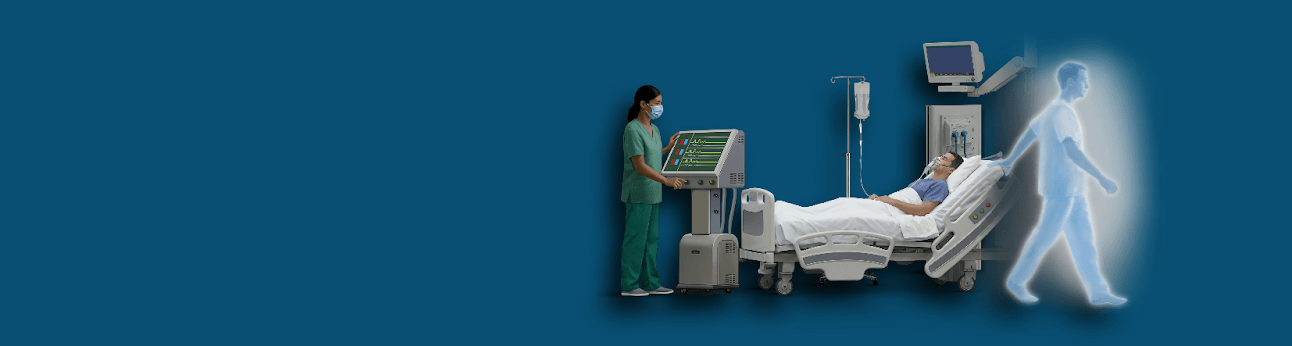
Given the education, training, and career arc of a CRNA, you’ve most likely seen a patient die or one who came close to dying experiencing a “clinical death” while under your care. During your early career in the ICU or some other critical care environment, you’ve cared for patients in extremis, either from their comorbid state, trauma, or the natural, inexorable progression towards end-of-life.
The death of a patient might have been observed for a variety of inevitable reasons: an ASA IV or V patient undergoing a high-risk surgery or severe trauma from an accident, perhaps even one that was self-inflicted. There may also have been an anesthesia care-related cause, which is increasingly rare due to various technological and patient safety protocol improvements. But what about the patients who have had near-death experiences (NDEs), those who appear to have died, or nearly so, saved by heroic or otherwise inexplicable reasons?
We vividly recall patients to whose bedsides we were urgently called following cardiac arrest, respiratory arrest, profound cyanosis, or life-threatening cardiac arrhythmias. Having placed a tube, then offering up aliquots of life-sustaining gas, our eyes sometimes met the open gaze of our patient below us, their eyes suspended in a state somewhere between living and dying, not knowing how the event would end.
Near-death through the lens of an accomplished actor
When we think of Jeremy Renner, several films immediately come to mind. American Hustle, The Hurt Locker, and Mission Impossible: Ghost Protocol, just to name a few. At his Nevada home in the wake of an epic snowstorm in January 2023, he was crushed while operating a 14,000-pound Snowcat as he reacted to an event that put his young nephew in danger. With dozens of broken bones, crushed internal organs, and an eyeball lying on his cheek that he could see with the other, breathing became entirely purposeful and no longer automatic, as he forced air in and out of a crushed chest. All of this transpired as things were shutting down. In the wake of this horrific trauma, lying in the snow and near death, he experienced what he termed an “exhilarating peace,” and “heard” family and friends—though not present at the accident site—collectively imploring him, from within his nebulous conscious state, to hold on. His entire life was seen all at once, echoing what so many others who experienced near-death have reported.
Renner described an enormous sense of energy as “beautiful, connected energy” and an incredible peace with what transpired. It was reported that he had died for several minutes and was airlifted for care that rescuers deemed futile. What he describes in his memoir finds commonality with that of many thousands of other near-death survivors studied by investigators like Dr. M Pehlivinova at the UVA Medical School, in Charlottesville, Virginia. Like other investigators worldwide, she studies what happens to the brain as death approaches—or when it arrives—but its finality is somehow, often astonishingly, avoided. Imagine, if you will, a precipice of sorts, with unconsciousness or oblivion wavering, but somehow consciousness, or something like it, prevailing.

Existential musing or science, or both?
It seems to be the domain of the philosopher, ethicist, or theologian where an out-of-body experience occurs, as reported by Renner and many others. Yet, with the tools of modern science and systematic, highly trained investigators, we’ve learned that when on that precipice, many report altered time perception, vivid sensations exceeding those felt in usual life, and a compressed review of their lived life. Also common is encountering a vague mystical presence and an intense feeling of peacefulness. Concerning the latter, Renner reported being “pissed off” at his rescuers for pulling him back from the peaceful sensation he was experiencing to the conscious pain and reality of his trauma.
There are studies of NDEs of ICU patients with findings very similar to what we’ve already noted. A widely accepted definition of an NDE in these studies is an episode of disconnected consciousness, characterized by internal awareness despite being completely unresponsive. In each instance, the occurrence takes place in a scenario where there appears to be no chance of survival.
Frequently reported by the ICU patients were altered time perception, vivid sensations that exceeded what they had experienced in normal life, and the emergence of a compressed review of their lifespan to date. Also commonly divulged was encountering a vague, mystical presence, having an “out-of-body experience,” and an intense feeling of peacefulness.
It is very tempting to get metaphysical here, and we will avoid that; instead, we will remain lock-step with objective science. In the CRNAs’ world, “clinical death” occurs when the heart stops, and blood flow ceases to critical organs like the brain. Death of the CNS, that is, “brain death,” follows. While the idea of externally compressing the heart of an animal to generate blood flow was not novel, it wasn’t until 1959 that clinician-scientists at Johns Hopkins, led by anesthesiologist Peter Safar, applied the technique now known as CPR to humans. Formally embraced by the American Heart Association and the Red Cross in 1962, many individuals were revived from “clinical death” before “brain death” ensued. There are well-documented events involving extraordinarily long resuscitation resulting in full recovery.
What the science of near-death experience is revealing
Empirically studying the neurobiology of NDEs, scientists have challenged traditional beliefs about the dying brain, especially the view that consciousness ceases almost immediately with the onset of cardiac arrest. This has potential implications for our current adherence to resuscitation algorithms, which may need to be upgraded.
A highly regarded team at the University of Michigan, led by neuroscientist Dr. J. Borjigin, published work in the Proceedings of the National Academy of Sciences, demonstrating a marked uptick in EEG activity known to be associated with consciousness—gamma activation—in the dying brain. Based on a strong foundation of animal research, Borjigin studied patients who were pre-identified as being at risk for cardiac arrest. In those whose hearts stopped, he obtained real-time EEG monitoring throughout their demise. All were comatose, unresponsive, and then removed from life support with their families’ permission. When support was discontinued, some individuals experienced a surge of gamma wave activity, which is known to be associated with consciousness. The activity was observed in the “hot zone of neural consciousness,” a term widely used by investigators in the domain. The small sample size necessitates studying this in a much larger set of ICU patients with grim prognoses, which is planned.
Consciousness is often described as having three dimensions: wakefulness, internal awareness, and connectiveness with the outside world. Consider for a moment what we are learning about NDEs and what we know about ketamine anesthesia. Both have extremely low wakefulness and connectedness but significant internal awareness. Hallucinations, meditation, and even fainting may involve high internal awareness but with low wakefulness and connectedness. What form(s) of consciousness emerge with NDEs?
Studying NDEs is ideal for what epidemiologists term a “natural experiment.” Many investigators interested in how the brain and consciousness work use psychedelic drugs and other manipulations. NDEs provide a life occurrence that might reveal the fundamentals of our consciousness, how we maintain it, and how it might be lost. Such “natural experiments” are insightful because when you disrupt or imbalance a system, you can learn a great deal about how it functions at the granular level.
A lot for us to think about, with more questions than answers to ponder. But this is precisely how science works, and with its worldwide attention by an eclectic cadre of investigators and muses, answers to complex questions will emerge, illuminating a currently dim landscape. Studying NDEs may inform resuscitation guidelines, deepen our understanding of how the mind works, unravel the mysteries of consciousness, and prompt us to think more deeply about the enigmatic nature of our existence.
We’re CRNAs ourselves, and we understand the challenge of fitting CRNA continuing education credits into your busy schedule. Whenever you’re ready, we’re here to help.
Related Articles