
Important update:
The Continued Professional Certification (CPC) Program has been retired and replaced by the Maintenance of Anesthesia Certification (MAC) Program, which now outlines the current requirements for CRNA recertification. All CRNAs are now recertifying under the MAC Program.
This update applies to the entire CPC Program, not just the Core Modules. With the transition to MAC, the CPC Core Modules formal is no longer part of the recertification pathway. For CRNAs who valued that style of learning, APEX now offers Clinical Practice Refresh, an upgraded alternative that lets you earn up to 30 Class A credits with the flexibility to earn credits incrementally.
In addition, the CPCA assessment is no longer used and has been replaced by the MAC Check, a longitudinal, quarterly knowledge assessment that supports ongoing learning as part of the MAC Program.
The NBCRNA CPC Program is no longer in use and has been replaced by the MAC Program. Previously, the CPC Program outlined how CRNAs maintained certification through continuing education and assessment. The information below outlines how the CPC Program was structured.
The 4 C’s of the CPC Program
The CPC Program previously supported lifelong learning for CRNAs through two 4-year cycles that repeat every 8 years. Today, CRNA recertification is governed by the NBCRNA’s MAC Program. If this sounds overwhelming, you’re not alone. Let’s break it down piece by piece.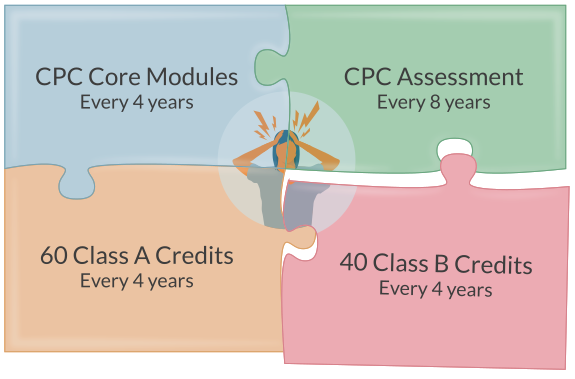
CPC Core Modules
Core Modules keep your clinical practice up-to-date with the evidence-based practice trends. They avoid the lag time it typically takes for new evidence to appear in the textbooks. The modules address the four domains of Nurse Anesthesiology practice:
- Airway Management
- Applied Clinical Pharmacology
- Physiology & Pathophysiology
- Anesthesia Equipment & Technology
You’ll also earn Class A credits by completing the Core Modules – this is the NBCRNA’s way of letting you “double-dip.” This means that the more credits you earn from your Core Modules, the fewer Class A credits you’ll have to buy elsewhere (cha-ching!)
Who sells the CPC Core Modules, and what do they cost?
Only CE providers officially recognized by the NBCRNA can offer Core Modules. These CE vendors undergo a rigorous (and expensive) application process over and above the AANA application for Class A credits.
Although all vendors jump through the same hoops to obtain approval, NOT all Core Modules are created equally. When you’re considering which ones are best for you, we recommend asking the following questions:
- What’s the quality of the content (i.e., is there an expert team behind the product)?
- How can I consume the content (video, audio, PDF, all three)?
- Is there prompt customer support if I need help?
- What’s the cost-per-credit?
Most CE vendors offer all four Core Modules at a cost of around $299.
⚠️ Although vendors may charge similar prices, some give you fewer Class A credits. This is a sneaky way to make you pay a higher cost-per-credit.
APEX gives you 23 Class A credits, so you can knock out over 1/3rd of your entire Class A credit requirement when you complete our Core Modules.
Here’s the complete list of Core Module providers officially recognized by the NBCRNA. One vendor offers a Core Module in non-surgical pain management, but you only have to do it if you hold the Non-Surgical Pain Management (NSPM) credential.
Do I have to complete my Core Modules?
No. CPC Core Modules are no longer required for CRNA recertification under the Maintenance of Anesthesia Certification (MAC) Program.
The CPC Program—including its required cycles and assessments—is being phased out. However, Core Modules remain available as an optional, NBCRNA-approved way to earn Class A credits (MAC Ed).
For CRNAs who have learned to value the structured, topic-based format of Core Modules, they can still serve as a familiar way to review key anesthesia topics such as pharmacology, airway management, and patient assessment.
How can I complete the Core Module content?
The answer depends on the vendor you choose. What would you like best? Video to get an immersive experience? Audio to learn on the go? PDFs you can read between cases? In-person on your vacation? Not all vendors offer all of these options.
To support flexible learning, APEX offers multiple ways to complete Core Modules without requiring time away from work:
Click each link for a quick demo:
Video
Audio
PDF
Do Core Modules include post-tests?
Yes. When Core Modules are used to earn Class A credits, the NBCRNA requires post-tests that differ from many other AANA-approved courses:
- Ten questions per hour of Class A credit
- Post-test questions cannot be reviewed after submission
- Post-tests are required even when modules are completed at live events
To ensure fairness, all Core Module providers are required to review post-test performance data and submit it to the NBCRNA. This process helps eliminate poorly performing questions. Most vendors allow multiple attempts to pass each post-test.
➡️ Have you learned to love CPC Core Modules? Sign up for Core Modules from APEX.
The CPC Assessment is now the MAC Check

Under the Maintenance of Anesthesia Certification (MAC) Program, the former CPC Assessment (CPCA) has been replaced by the MAC Check. The MAC Check is a longitudinal, quarterly knowledge assessment designed to support continuous learning rather than a single, high-stakes exam.
Like the former CPCA, the MAC Check assesses core domains of nurse anesthesiology practice, including:
- Airway management
- Applied clinical pharmacology
- Physiology and pathophysiology
- Anesthesia equipment and technology
Unlike the CPCA, which functioned as a periodic assessment of retained knowledge, the MAC Check provides ongoing feedback over time to help CRNAs identify strengths and areas for continued learning across practice domains.
Class A Credits

CE credits are categorized as Class A and Class B. You must earn 60 Class A credits EVERY 4-year cycle.
What CE activities award Class A credits?
You can earn Class A credits from online courses, live meetings, webinars, and Core Modules. Activities that award Class A credits must meet two requirements:
- They’re prior approved by the AANA (i.e., they have an AANA prior-approval number)
- They include an assessment, such as a live discussion, simulation, or post-test.
- You’ll get a certificate of completion when you earn Class A credits, and many CE vendors will report your credits directly to the AANA if you’re an active member.
Be careful, though. While some vendors report daily, others may only report once a month and charge a fee if you need them sooner.
If you’re not an AANA member or your vendor doesn’t report to the AANA, you’ll need to report your credits yourself. This resource will guide you through the process.
CE Documentation Guidelines – Applicants Without AANA Credit Transfer
Class B Credits

You must earn 40 Class B credits EVERY 4-year cycle.
Alternatively, you can earn additional Class A credits (beyond your required 60) to satisfy your Class B requirement. For example, a CRNA who earned 70 Class A credits only needs to complete 30 (not 40) Class B credits to satisfy the 100 total credit requirement.
What CE activities award Class B credits?
Class B credits—also referred to as MAC Dev under the Maintenance of Anesthesia Certification (MAC) Program—support professional development activities that extend beyond formal clinical education.
Unlike Class A (MAC Ed) credits, Class B credits are not prior approved by the AANA and do not include an assessment or certificate of completion. CE vendors do not report these credits on your behalf, so it’s important to maintain accurate documentation of all Class B (MAC Dev) activities.
Activities that may count toward your Class B (MAC Dev) requirement include research, publishing, teaching, M&M conferences, anesthesia podcasts, and mission trips.
These resources will help:
1. Activities that award Class B credit
2. Class B credit reporting document (this is how you’ll report your Class B credits to the AANA)
Add CPC Core Modules to Your Existing CE Plan
Did you know APEX continues to offer CPC Core Modules as an optional way to earn Class A credits as part of your continuing education? If you’re ready to explore a structured, topic-based learning option, check out our CPC Core Modules.
Know anyone else who’d benefit from this information? Use the share buttons below to help your CRNA friends and colleagues.
Updated 12/18/2025
Related Articles