For decades, insulin got most of the attention in glucose physiology, and glucagon was treated as its less important partner. That has changed. Research on glucagon and its related peptides led to GLP-1 receptor agonists (GLP-1RAs), one of the biggest drug stories in years. For CRNAs, that means these drugs now turn up in the perioperative caseload every day.
In our recently released CRNA Updates Volume 6, we explore this topic in greater detail than what you’ll find below. If this type of continuing education interests you, be sure to check out our CRNA CE courses.
The following is a quick tour of glucagon, the drugs it inspired, and current guidance on caring for patients who take them.
What is glucagon?
Glucagon is a small peptide hormone of 29 amino acids, weighing about 3,485 daltons (insulin is 5,808). Alpha cells in the pancreas’s islets of Langerhans make it. The strongest trigger for its release is low blood glucose. When glucose drops, glucagon tells the liver to raise it.
The pancreas works as two glands. As an exocrine gland, it secretes 1-4 liters of digestive enzymes per day. As an endocrine gland, it releases hormones from several cell types:
- Alpha cells: glucagon
- Beta cells: insulin
- Delta cells: somatostatin, which acts as a brake on other hormones
- PP cells: pancreatic polypeptide, which slows gastric emptying and reduces exocrine secretion1
- Epsilon cells: cells that influence appetite, fat storage, and growth hormone release
A simple way to picture it: glucagon mobilizes glucose and insulin deposits it. When the system works, alpha and beta cells balance each other and keep plasma glucose steady.
The name dates back to the early 1920s. Researchers Kimball and Murlin found a “glucose agonist” in pancreatic extracts and combined the first letters of each word: glucose agonist2.
How glucagon is made and cleared
Glucagon starts as proglucagon. Proglucagon is made in pancreatic alpha cells, in intestinal L cells, and in small amounts in the brainstem and hypothalamus. The enzyme that processes it depends on where it’s made: PC2 in the pancreas, PC1/3 in the gut and brain. Both routes can produce glucagon, GLP-1, and GLP-2.
Glucagon release goes up with hypoglycemia, prolonged fasting, protein meals, exercise, stress, epinephrine, and vasopressin. It goes down with glucose, insulin, somatostatin, and carbohydrate meals. Once released, glucagon persists in plasma for about 5 minutes3. The enzyme dipeptidyl peptidase-4 (DPP-4) breaks it down, and the liver and kidneys clear it.
What glucagon does
- Triggers hepatic production of glucose: it drives glycogenolysis and gluconeogenesis, and blocks glycolysis and glycogen synthesis. This response is fast and can be life-saving in severe hypoglycemia.
- Keeps energy balance during fasting, cold, or exercise: It breaks down fatty acids as a non-carbohydrate fuel.
- Makes glucose from amino acids during prolonged fasting.
- Turns ammonia into urea for excretion by the kidneys.
- Reduces appetite at high doses: This effect, seen since the early 1990s, was an early hint at the role of the GLP-1 receptor 4,5.
There are also less-settled claims that glucagon activates brown fat6 or helps with myocardial depression from beta-blocker or calcium channel blocker overdose7. The evidence for both is limited.
Glucagon for severe hypoglycemia
According to ADA guidance, a blood glucose level of 55–70 mg/dL is considered mild hypoglycemia and still requires treatment. Below 55 mg/dL it’s moderate if the patient can treat themselves, and severe if they need someone else’s help8. Warning signs include altered mental status, dizziness, fainting, seizures, and coma.
Three rescue formulations are available9:
- Nasal powder: needle-free, simple for caregivers, and usable in an unconscious patient.
- Prefilled autoinjector: shelf-stable, no mixing needed, given in the upper arm, thigh or abdomen.
- Traditional kit: a powder that must be mixed with a diluent before injection.
GLP-1 receptor agonists
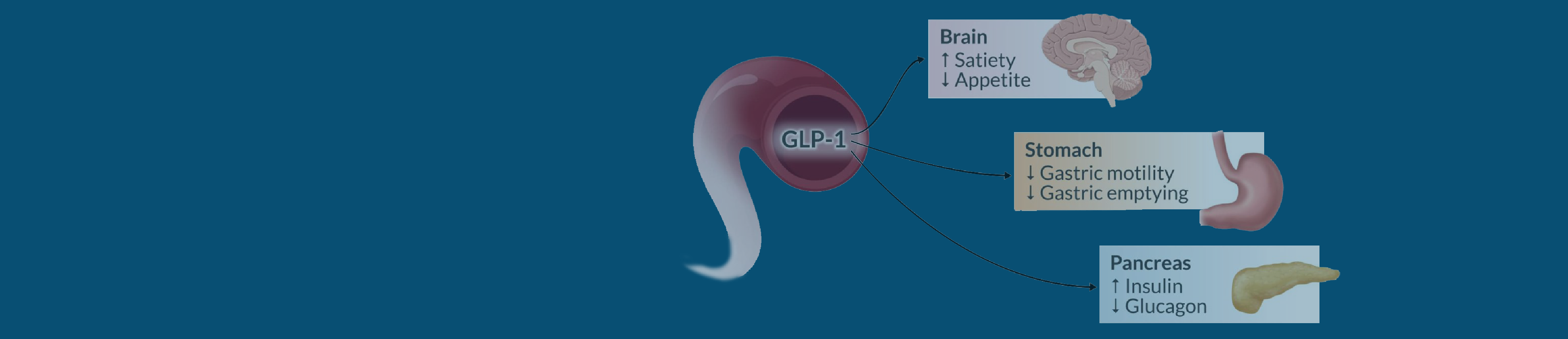
GLP-1 is found throughout the body, including the brain, gut, heart, liver, kidneys, and fat tissue. The natural hormone is rapidly degraded by DPP-4, so chemists modified its structure to design drugs that last longer10. GLP-1RAs:
- Increase insulin release and reduce glucagon release, lowering glucose with little risk of hypoglycemia
- Reduce appetite through the hypothalamus11
- Slow gastric emptying, causing a form of gastroparesis that matters in anesthesia10
- Improve beta-cell function, lipid profiles, blood pressure, and weight management12
Familiar agents include exenatide (Byetta), liraglutide (Victoza), semaglutide (Ozempic/Rybelsus), albiglutide (Tanzeum) and tirzepatide (Mounjaro). Newer drugs act on more than one receptor. Tirzepatide targets both the GIP and GLP-1 receptors. Retatrutide targets the GLP-1, GIP, and glucagon receptors. More than 100 other GLP-1RAs are in clinical trials. Researchers are studying them for Parkinson’s disease, Alzheimer’s disease, cardiovascular conditions, and fatty liver disease (NASH/MASH). Science named GLP-1RAs its 2023 Breakthrough of the Year13, though some direct-to-consumer ads for these drugs promise more than the evidence supports.14
Common side effects include nausea, vomiting, diarrhea, anorexia, dizziness, headache, tachycardia, and injection-site reactions. Rare but serious risks include pancreatitis, kidney injury, and thyroid cancer15.
Perioperative guidance
These drugs slow gastric emptying, which raises the risk of regurgitation and aspiration under anesthesia. The ASA’s 2023 consensus guidance recommends16:
- Daily dosing: hold the drug on the day of the procedure.
- Weekly dosing: hold it for the week leading up to the procedure.
- Diabetic patients held longer than one dosing interval: consult endocrinology to prevent hyperglycemia.
- Drug not held: use full-stomach precautions, consider gastric ultrasound, and discuss whether to delay the procedure.
The guidance is contested. Gastroenterology and endoscopy societies have argued that holding the drugs isn’t necessary16. Newer work suggests continuing therapy and managing aspiration risk in other ways, because stopping the drug can disrupt glucose control and lead to weight regain. One option for high-risk patients is a liquid-only diet for at least 24 hours before the procedure17.
The bottom line: The evidence isn’t strong enough for firm rules appropriate for all patients. Take extra care in elective cases where the patient has significant GI symptoms. Make each decision case by case with the whole team: the CRNA, the prescribing provider, the proceduralist, and the patient and their family.
CRNAs can read additional reflections on the latest anesthesia-care-related guidance and clinical considerations in the full article in CRNA Updates Volume 6, which is now also part of the CRNA CE All-Inclusive Bundle.
References
- Inui A, Katsuura G. Pancreatic polypeptide. In: Handbook of Hormones. 2nd ed. 2021:367.
- Kimball C, Murlin J. Aqueous extracts of pancreas: some precipitation reactions of insulin. J Biol Chem. 1923;58:337.
- Pontiroli A, et al. Pharmacokinetics of intranasal, intramuscular and intravenous glucagon in healthy subjects and diabetic patients. Eur J Clin Pharmacol. 1993;45:555.
- Geary N, et al. Individual, but not simultaneous, glucagon and cholecystokinin infusions inhibit feeding in men. Am J Physiol. 1992;262:R975.
- Habegger K, et al. The metabolic actions of glucagon revisited. Nat Rev Endocrinol. 2010;6:689.
- Müller T, et al. The new biology and pharmacology of glucagon. Physiol Rev. 2017;97:721.
- Graudins A, et al. Calcium channel antagonist and beta-blocker overdose: antidotes and adjunct therapies. Br J Clin Pharmacol. 2016;81:453.
- American Diabetes Association. Low blood glucose (hypoglycemia). https://diabetes.org/living-with-diabetes/hypoglycemia-low-blood-glucose
- American Diabetes Association. How to use glucagon. https://diabetes.org/living-with-diabetes/hypoglycemia-low-blood-glucose/how-use-glucagon
- McLean B, et al. Revisiting the complexity of GLP-1 action from sites of synthesis to receptor activation. Endocr Rev. 2021;42:101.
- Secher A, et al. The arcuate nucleus mediates GLP-1 receptor agonist liraglutide-dependent weight loss. J Clin Invest. 2014;124:4473.
- Drucker D. GLP-1 physiology informs the pharmacotherapy of obesity. Mol Metab. 2022;57:101351.
- Thorp HH. More questions than answers. Science. 2023;382:1213.
- Mattingly T, Conti RM. Marketing and safety concerns for compounded GLP-1 receptor agonists. JAMA Health Forum. 2025;6:e245015.
- Cleveland Clinic. GLP-1 agonists. https://my.clevelandclinic.org/health/treatments/13901-glp-1-agonists
- Joshi G, et al. ASA consensus-based guidance on preoperative management of patients (adults and children) on GLP-1RAs. 2023. https://www.asahq.org/about-asa/newsroom/news-releases/2023/06/american-society-of-anesthesiologists-consensus-based-guidance-on-preoperative
- Joshi G. Preoperative strategies for patients on glucagon-like peptide-1 receptor agonists: navigating current controversies and future directions. Anesthesiology. 2024;141:1031.
Related Articles