
There is great joy, bliss if you will, of bringing a child into the world. This single event is transformative, as our full attention is given to simple, comfortable clothing, car seats, nursery room decor, and optimally sized diapers. All of which are prioritized over previous material pursuits. The world is luminous, and expectations are high. But in the event of sudden infant death syndrome (SIDS), it’s as if a total solar eclipse occurred as the Moon passes between the Sun and Earth, obscuring the light source. The parents are left in what feels like an infinite void of darkness.
The event is utterly destabilizing, with immediate and long-term consequences. The horror is amplified by the home often becoming a literal crime scene with emergency medical workers, police, and coroners taking center stage. The grieving family is suspended in a sea of guilt, confusion, and desperation, feeling abandoned by a healthcare system that shouldn’t have let this happen.
CRNAs, not just those working in obstetrical and pediatric intensive care settings, by virtue of their training, knowledge, and experience, are ideally suited to provide health education to patients, their family members, and others in the community regarding SIDS and its prevention. At the risk of generalizing, CRNAs tend to be highly motivated and empathetic, with excellent communication skills.
What do we know and don’t know about SIDS
SIDS is the sudden death of an infant (< 1-year-old) from an unidentified cause, following a detailed case analysis that includes autopsy, death scene examination, and medical history review. The American Academy of Pediatrics (AAP) recognizes the use of the term SUID (sudden unexpected infant death), which is a catch-all term that includes SIDS, and other accidental bed/sleep-related deaths by suffocation, strangulation, or another unclear reason.
The use of social media platforms of all kinds is increasingly viewed as a kind of 2-edged sword. Along with the many upsides come the potential to promote a punitive culture, spread misinformation, or misinterpret otherwise factual material. If you scroll through Instagram using the hashtag #sleepingbaby, you will find countless photos of sleeping infants in postures and places that do not follow the guidelines of the AAP. The photos show the infants sleeping face down, surrounded by pillows, bumpers, plush blankets, and stuffed animals, disregarding the AAP’s sleep-safe recommendations.
In the 1990s, SUID rates decreased, then essentially plateaued through 2010, and then in 2020, began to increase. In a recent JAMA Pediatrics, epidemiologists and pediatric specialists reported a death rate of SUID rising about 12%, from 90 deaths per 100,000 live births to a little over 100 deaths. Also concerning, in fact, alarming, is that while the rate was lowest among Asian infants (22/100,000), it was highest in Black infants (238/100,000). Nationwide, some 2,500 infants die each year in the U.S. from SUID.
A theory, but the currently dominant one of SUID
As the deaths occur during sleep in otherwise healthy and well-cared-for infants, the precise physiological point of failure goes unobserved. Despite decades of research, distinguishing between a primary cause of death and a secondary factor (or more) remains extraordinarily challenging. Current best evidence and thinking suggest the “triple-risk model of SUID.”
This prevailing theory describes 3 major factors:
- A vulnerable infant (genetics, brainstem abnormality, male, prematurity)
- Up to 4 months of age, there is a critical physiological window of breathing and other autonomic nervous system development.
- External factors (sleep position, bedding, sleeping on soft surfaces, high temperature, smoking exposure) that play a role.
Many other factors may be operative in select cases. For example, the mother’s health likely plays a significant role in the infant’s health, and how the infant is cared for may play a significant role as well. What is clear is that the only actionable item in the home is the “external factors.”
What CRNAs can do
Perhaps you meet a patient preoperatively and learn that they have an infant at home. On the labor and delivery unit, your opportunities to engage with a target audience abound. Maybe you have a pregnant neighbor who has recently brought their infant home. You may even network with your colleagues at work or at a state conference and start a discussion. Like wearing seatbelts, having smoke alarms in the house, or not overloading electrical extension cords, some things cannot be overemphasized or reminded too frequently.
What should we emphasize when talking about SIDS or SUID?
The conversation should not be characterized by medical-level vocabulary, frightening scenarios, or judgmental language. A good start might be to ask open-ended questions like:
- What have you heard about safe-sleep for your baby?
- What do you have in mind for the crib, bassinet, Moses basket, or travel crib?
- Are you thinking about bed-sharing with your baby?
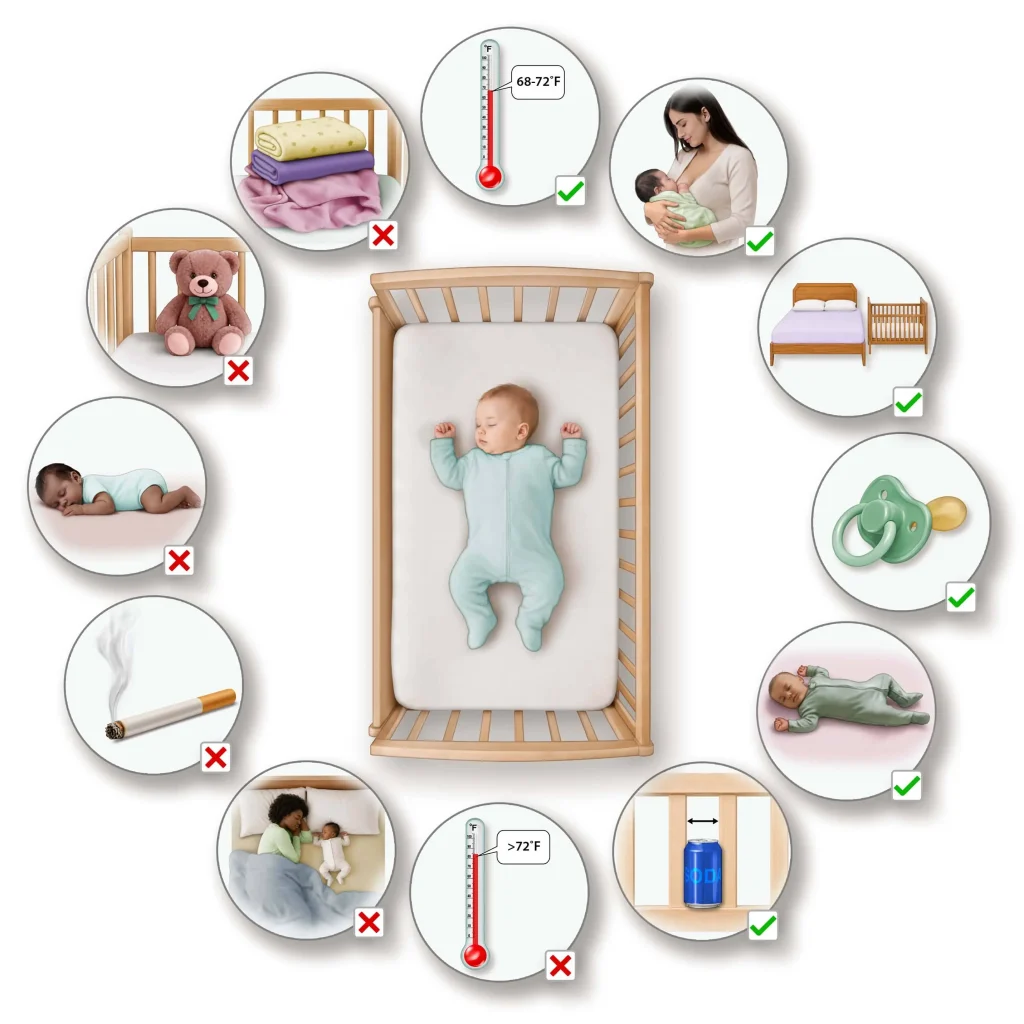
Using these as discussion starters, it should be easy to move on to the points strongly recommended by the AAP and other stakeholder societies. In a calm, professional, and supportive voice, you can encourage them to:
- Share a room but not a bed. Co-sleeping greatly increases the risk of suffocation. Consider placing the infant in their own sleep space for the first months of life.
- Place the infant on their back (“back to sleep” is the mantra). Avoid placing them on their sides or tummies during naps and extended sleep time.
- Use a firm, flat sleep surface in the cribs, bassinets, and “play yards.” When selecting a crib, look for one that is AAP-approved. The distance between the rails of the crib should be no greater than the width of a soda can.
- Avoid couches, armchairs, swings, rockers, or even car seats (except when traveling in the car) for infant sleep time.
- Clear the sleep area, no fluffy blankets, stuffed animals, or pillows. The sleep surface and any borders of the sleep area should not indent. Only fitted sheets that conform tightly to the sleep surface should be used.
- Avoid overheating the infant; dress them appropriately for the room temperature during sleep.
- Maintain a nonsmoking and drug-free environment for the infant.
Additional talking points recommended by the AAP include the finding that breastfeeding is associated with a lower risk of SIDS and that giving an infant a pacifier at naps and for longer sleep-time may also lower the risk. When breast- or bottle-feeding the baby, stay alert and attentive! And remember, consulting social media platforms about SIDS should generally be avoided as they may provide incorrect information and cause unnecessary anxiety.
Our strength is in our knowledge and experience, but also in our numbers
There are close to 60,000 CRNAs and current program trainees in the U.S. Imagine, if you will, that even if some small percentage of us try to appropriately approach and render education to a relevant party, might we have an impact? Might we reduce some of those 2,500 annual deaths? We believe so.
We understand the challenge of finding and earning CRNA CE credits while also maintaining a busy schedule. Whenever you’re ready, we have a course that fits what you need to meet the NBCRNA MAC program requirements.
Related Articles