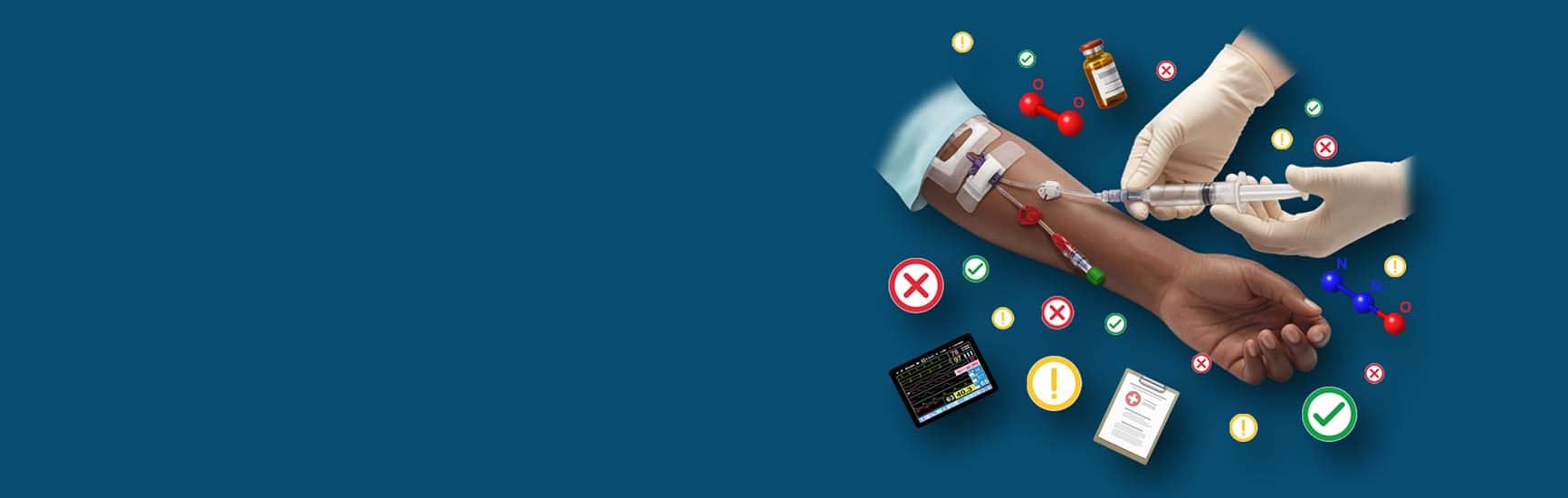
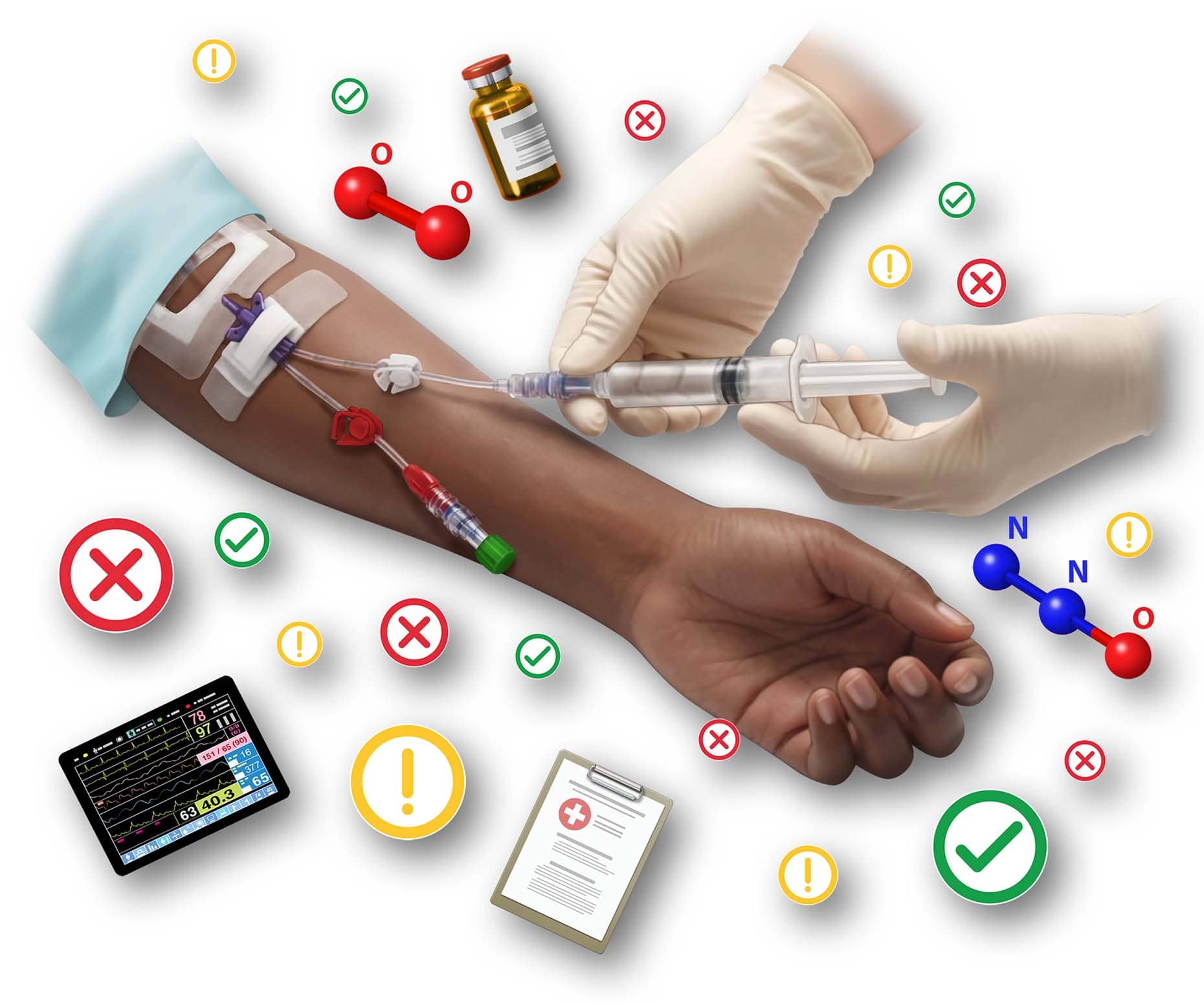
CRNAs are in a rather unique and somewhat disquieting position, in that we daily intravenously administer very powerful and unequivocally dangerous drugs (in terms of their potential) to patients who have never had the experience before. Based on our education, training, and experience, we have a dose in mind, administer the drug, and await its outcome. The intent may be to relieve pain, relax muscles, lower blood pressure, or, in the case of propofol, induce light, moderate, or profound hypnosis. Often, the effect is just as we had anticipated, but on occasion, we undershoot or overshoot the mark and may even observe unexpected side effects.
CRNAs practicing in the pre-propofol era of anesthesiology would commonly administer a test dose of thiopental sodium (sodium pentothal) before administering the calculated dose. The variability in patient response to the drug was so great that, in some patients, even a small dose of the drug resulted in profound hypnosis. Using a test dose largely disappeared with the advent of propofol, FDA-approved in 1989 and marketed as Diprivan™, which was deemed a safer hypnotic with fewer side effects, plus it was markedly superior as it did not provoke the dreaded PONV profile of thiopental.
But the pharmacodynamics of propofol, just one of the many drugs we administer, varies considerably among patients we care for, often quite unpredictably. The metabolism of propofol in the human body is enormously complex. A tongue-twisting enzyme, uridine 5’-diphosphate-glucuronosyltransferase (mercifully abbreviated as UGT), results in its conjugation to propofol glucuronide, accounting for 70% of an injected dose excreted renally, and at least two cytochrome P450 enzymes account for almost 30% of its metabolism. A tiny amount, less than 1%, is excreted unchanged, and a literal whiff of it is exhaled.
Given these complexities, it is understandable that any factor that alters propofol’s metabolism and clearance could affect clinical outcomes. And sure enough, patients may metabolize propofol differently due to genetic polymorphisms, common variations in specific DNA sequences that occur as part of natural genetic diversity in humans. Armed with knowledge of a patient’s pharmacogenomics before administering propofol, we should be able to not only hit the hypnotic target with greater precision but also minimize the risk of adverse events that could muddy the clinical picture.
When we first encounter a patient, often not until they arrive at the preoperative/preanesthetic holding area, and in rare cases, not until they are lying before us in the OR, we often rely on two questions to ascertain the risks associated with the drugs we use:
- Have you had anesthesia before (and if that’s a “yes”), were you informed of any problems you may have experienced?
- Has anyone in your family (parents, grandparents, brothers, or sisters) had a problem with an anesthetic?
Perhaps you’ve not thought of it this way, but by asking these questions, we are seeking genomic clues that may alert us to an outlier in their response to an anesthetic drug. We would argue that in our role as vanguards of patient safety, CRNAs are, at the most fundamental level, clinical pharmacologists. We draw from a deep understanding of the drugs we employ and how they perturb or enhance human physiology. Consider the following table of some of the drugs we routinely use, with a column describing how each is metabolized, understanding that other biochemical actors may be involved.
| Anesthetic drug or adjunct | Major metabolic factor |
|---|---|
| Ketamine | Cytochrome enzyme (CYP3A4) |
| Etomidate | Hepatic ester hydrolysis |
| Remifentanil | Nonspecific esterases |
| Succinylcholine | Butyrylcholinesterase |
| Codeine | CYP2D6 & UGT |
| Synthetic opioids | Cytochrome enzyme (CYP3A4) |
| Benzodiazepines | Cytochrome enzyme (CYP3A4) & conjugation |
| Remimazolam | Carboxylesterase |
| Sevoflurane | Cytochrome enzyme (CYP2E1) |
Our dependency on achieving a target drug dose at the site of action is subject to many genetic modifiers. Consider that every molecule playing a role in a drug’s metabolism is encoded by some critical bit of our genome, and we are likely unaware of polymorphisms, or even rarer mutations, that may be present. Inadequate metabolism may result in excessively high and persistent drug levels, while hypermetabolism may result in an inadequate level or an unanticipated abbreviated duration of a desired effect.
Prodrugs: An inactive molecule awaiting its therapeutic awakening
Prodrugs account for over 10% of all drugs currently in use, with the tendency to create prodrugs increasing. Poor or absent metabolism may render a prodrug ineffective (consider clopidogrel), and a hyper-metabolizer may result in excessively high drug concentrations (consider codeine). The table below lists common prodrugs and their corresponding metabolizers.
| Prodrug | Metabolizing enzyme or molecule |
|---|---|
| Enalapril | CES-1 |
| Clopidogrel | Cytochrome enzyme (CYP2C19) |
| Aspirin | Plasma & tissue esterases |
| Prednisone | 11ß-HSD1 & CYP3A4 |
| Levodopa | Decarboxylase |
| Codeine | Cytochrome enzyme (CYP2D6) |
Uncertainty and the quest to extinguish it
The 15th and 16th centuries were considered the “Age of Discovery.” Columbus sailed from Spain into uncharted waters, literally stumbling upon the Americas. Vasco da Gama navigated around the treacherous Cape of Good Hope, reaching what we now know as India. Magellan’s 1519-1522 circumnavigation of the globe (well, not exactly, he died during the voyage) covered nearly 38,000 miles of totally unknown terrain. These intrepids were learned, knew the Earth was a globe, yet great uncertainty prevailed as they sailed into unknown territory. Their voyages accelerated the evolution of maritime science and technology, and while rudimentary at first, continued illumination shrank the shadows of uncertainty. The certainty of sea navigation prospered.
CRNAs manage uncertainty with time-tested and proven tools. Among these are practice standards, algorithms, communication, teamwork, and technology. We assess the airway, probe the patient’s physiology, and obtain actionable information that permits patient-centric decision-making. Information fosters safe and effective clinical care.
An information niche that is missing, but on the horizon
The clopidogrel story
This P2Y12 antagonist is a mainstay of antiplatelet therapy in a range of clinical scenarios, many of which are extremely high-risk. Because it is a prodrug that requires bioactivation by CYP2C19, an enzyme encoded by the same-named gene, knowledge of the gene’s integrity is vital to ensure the drug works and to permit personalized medical care.
The Spartan RX CYP2C19 System emerged as a bedside, point-of-care device requiring only a buccal swab to assess the gene’s functionality. Ease of use, rapid access to information (<60 minutes), and validation of the obtained information, compared with traditional blood testing, demonstrated the feasibility and utility of this approach.
The emergence of point-of-care pharmacogenomics
Pharmacogenomics has emerged as a new-ish kid on the block, wedging pharmacology, genomics, and personalized medicine to determine a patient’s unique genetic architecture and how it influences their response to medications. A simple Google search reveals over a dozen entities pursuing the goal of making it portable, cost-effective, and speedier. The demand from primary care providers, clinics, institutions, and patients is growing, as is the knowledge, technology, and innovative spirit of those in pursuit.
Already, companies offer a service in which one self-collects a buccal swab, places it in a prefabricated folder, mails it along with the payment, and then receives detailed genomic information in the days or weeks that follow. The technological infrastructure is there; marshaling it to the patient’s bedside in real time to achieve detailed pharmacogenomics is so close. So it’s important to know, both for ease of harvesting and patient comfort, that a simple buccal swab can work just as well as a blood sample!
As with those early (ancient!) seafaring intrepids and the ever-lessening of precarious voyaging, the shadow cast by pharmacological uncertainty is shrinking by the day. Soon, we predict, a buccal swab, or a drop of blood, obtained when we first meet our patient, will allow us to personalize our anesthetic drug choices in real time when we first meet our patient. This will permit optimizing drug selection and dose in a manner previously unattainable. Uncertainty dispatched.
And to go a step further, imagine if those early oceanic navigators had artificial intelligence (AI) at their disposal! Now, envision the triad of genomic testing, AI, and the CRNA all focused on one thing: optimizing drug administration in the unique genomic entity lying on the OR table, our patient. It’s just a matter of time.
We understand the challenge of finding and earning CRNA CE credits while also maintaining a busy schedule. Whenever you’re ready, we have a course that fits what you need to meet the NBCRNA MAC program requirements.
Related Articles