
Key Takeaways: The Lone Star tick’s spread means more surgical patients will arrive with alpha-gal syndrome — and the OR is full of hidden triggers. Heparin, certain opioids, gelatin-based hemostatics, bioprosthetic valves, and even acetaminophen can carry animal-derived constituents capable of triggering anaphylaxis in sensitized patients. Screen during preanesthesia assessment, confirm with alpha-gal IgE testing, swap in safe alternatives (bivalirudin over heparin, for example), premedicate with antihistamines and steroids, and keep anaphylaxis treatment immediately at hand.
We have often wondered: can’t we just rid the Earth of the mosquito, an animal that causes more deaths than any other? No more fear of malaria, Zika virus, dengue, West Nile virus, Japanese and St. Louis encephalitis, and many other maladies? And gone to those itchy, bothersome bites!
To test our view, we contacted a professor of entomology at our local university and got an earful. Were that to happen, we’d turn the natural, global ecosystem topsy-turvy. Frogs, bats, fish, and birds would starve. Crop and flower pollination in cold regions of the world would falter or cease entirely. Our expert went on to suggest that the migration patterns of certain animals, such as caribou, would be altered, with devastating ecological consequences. For example, certain migrating animals select paths to avoid the “mozzies” (she’s from Australia, and that’s how they’re known there) or “skeeters” as those below the Mason-Dixon line spitefully refer to them.
Perhaps our view of the mosquito merits moderating, but we’re drawing a line in the sand and not budging from our view that ticks deserve extinction! These oval, 8-legged heinous creatures, varying in size from a poppy seed to one measuring a little over an inch, would benefit us all if they’d disappear. They bite, procreate, and may infect us with a variety of bad, if not life-altering, diseases. For now, of the almost 900 types of ticks that are out there, let’s zero in on one, Amblyomma americanum, better known as the Lone Star tick (LST), and what a bite from it may cause when its victim subsequently eats red meat.
These nasties play important roles in the transmission of bacterial, protozoal, and viral illnesses in humans and in dogs, cats, birds, and a variety of woodland creatures. Something that chillingly characterizes the LST, in contrast to sit-and-wait ticks that access us as we brush by them on a walk or bike ride, is that it is an aggressive pursuer, attracted to our CO2 emissions and the vibrations we create with our movement. Yikes! To make matters worse, they reproduce in a way that produces ‘tick bombs’ — clusters of hundreds to a thousand or more nymphs that can literally swarm all over you. The upside of the tick bomb is that they have not yet had their first meal, and thus are less likely to carry infectious risk or be immunoreactive.
The LST does not vector Lyme disease (which generally gets all the attention), but it can transmit some nasty bacterial diseases, such as tularemia, Rocky Mountain spotted fever, and a group of conditions called ehrlichiosis. Viral vectoring can result in a large group of viruses with odd names, for which there is no specific treatment; only supportive care is available. Bourbon virus, Heartland virus, Tacaribe virus, and several others are easily spread geographically by the LST, tagging along on migrating birds. Yes, airborne dissemination of the critters!
Alpha-gal syndrome (AGS)
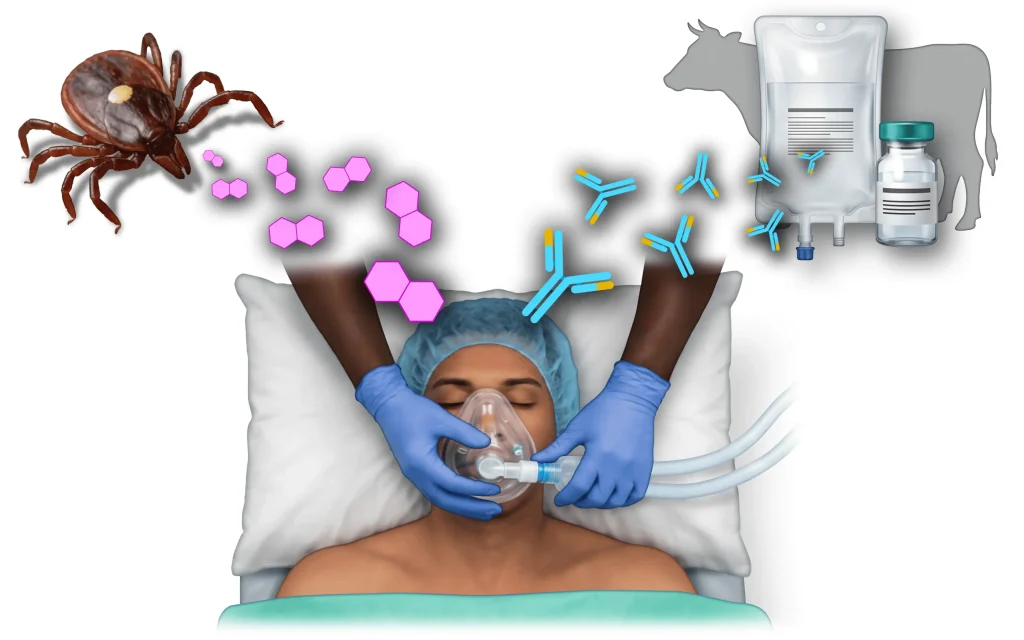
AGS is the intent of our blog, increasingly on our radar, and unusual because it does not involve an infectious agent. Instead, it is an immune response triggered by the presence of a sugar (galactose-alpha-1,3-galactose—i.e., alpha-gal) in the blood. A quirk of nature is that it is found in all mammals except for humans and apes.
Think of the LST feasting on a woodland mammal, and in that meal, it self-inoculates with a trace of that animal’s sugar, alpha-gal. Should the tick then bite a human, a trace amount of the alpha-gel antigen from its salivary glands (yes, ticks have them) is all it takes to trigger a later meat-mediated immune response in the human. The IgE-mediated human response varies in intensity from one person to another. It may take hours to manifest, but some will experience a significant response, especially when eating red meat. This response ranges from generalized itching to GI distress to anaphylaxis. Some may even experience allergic reactions to chicken, dairy products, and drugs containing animal products such as gelatin and lactic acid. Adverse reactions to certain chemotherapeutic agents initially raised concerns about AGS, but it wasn’t until 2011 that the link between LST and AGS was established.
A closer look at alpha-gal
It goes back to a name you may recall: Karl Landsteiner, who first described the ABO blood group system that guides modern transfusion practice. His work laid the foundation for understanding blood group antigens — including the discovery, decades later, that alpha-gal is structurally similar to the blood group B antigen found on the cells of most mammals (humans and apes excluded). When sensitized individuals eat red meat, symptoms typically appear 4–6 hours after consumption, a delayed reaction that sets alpha-gal syndrome apart from typical food allergies.
This delayed reactivity is unusual, given what we know about IgE-mediated anaphylaxis. This contributed to the slow recognition of meat, typically beef, pork, or lamb, as the triggering culprit. When bitten by the LST, we produce alpha-gal antibodies, and with subsequent red meat consumption containing the alpha-gal sugar, an allergic response occurs. Urticaria, bronchoconstriction, angioedema, and, of course, anaphylaxis are the most worrisome manifestations. Avoiding red meat is associated with a lower risk of reported reactions.
The increasing incidence of AGS may be related to the rise in the whitetail deer population, serving as an abundant and highly mobile host for the LST. A delay in symptom onset may be due in part to the digestion of consumed meat triggering AGS, or to an as-yet undescribed pathway. Summing it all up, the road to discovering the underpinnings of AGS has not been easy to navigate.
What AGS means for CRNA practice
We found reports of alpha-gel reactions in surgical patients who received acetaminophen, hydrocodone, naproxen, clonidine, porcine-derived heparin, and even lisinopril. Magnesium stearate or lactic acid, from animal sources, is often used in their production. Many surgical formulations may contain gelatin-based hemostatics such as Surgifoam™, xenografts, biomesh, bioprosthetic heart valves, and even collagen sutures. Vaccines may also involve animal products. Protamine is safe, as it is derived from a non-mammalian source.
Keeping all this in mind is important during the preanesthesia assessment, and if there is an indication that the patient may have AGS (e.g., red meat allergy, prior LST bite, etc.), perioperative management is critical. Identifying risk may be quite challenging, as some patients with alpha-gal may have minimal effects while others may experience anaphylaxis. If the risk is considered significant, you might consider getting an alpha-gal IgE level to confirm your suspicion, but it may not predict the intensity of the allergic response.
The table below summarizes the major concerns we identified in published case reports and the medical literature. Fortunately, most of our mainstay anesthetic agents appear to be okay to use.
| Compound | Concern | Notes* |
| Heparin, enoxaparin | Major concern: may trigger a reaction | Often comes from a bovine or porcine source |
| Hydromorphone | May contain gelatin or magnesium stearate | Important to ascertain ingredients |
| Pregabalin, gabapentin | May trigger a reaction | Check ingredients |
| Morphine | “Usually” safe, but may trigger a reaction | Preparations may have mammalian constituents |
| Haloperidol | May trigger a reaction | Check ingredients |
| Vasopressin, clevidipine, Milrinone, lisinopril | May trigger a reaction | Formulations may contain mammalian constituents |
| Gelatin-based volume expanders | May trigger a reaction | Check ingredients |
| Acetaminophen | May trigger a reaction | Tablets and certain IV preparations may contain mammalian constituents |
| Exparel™ (liposomal bupivacaine) | May trigger a reaction | Glycerol may be a constituent in some products |
*When in doubt, speak to your institution’s pharmacist, as not all vials reveal processing ingredients.
Getting rid of ticks is unlikely
From our admittedly cursory review of the entomology (bug) literature, ticks are flourishing, and we will likely see more patients with a history of alpha-gal who are at risk of allergic reactions to procedures or drugs that we, or the surgeon, use. Ideally, those with alpha-gal should be identified and risk-managed before the day of surgery. The takeaways from the literature, which is rapidly expanding, are:
- Maintain a high index of suspicion and carefully assess patients’ risk for AGS
- When a diagnosis of AGS is confirmed, despite the absence of consensus guidelines and after discussion with the surgeon, avoid drugs known to trigger allergic phenomena. For example, instead of heparin, consider intraoperative bivalrudin or argatroban, for long-term anticoagulation, fondaparinux, or DOACs like apixaban or rivaroxaban.
- Premedication with antihistamines and steroids may be appropriate.
- Be prepared to treat allergic manifestations, including anaphylaxis.
Nature has a way of relentlessly exercising its dominance, with humans trying, largely unsuccessfully, to level the playing field. The LST, like so many of nature’s constituents, will prevail despite even our most herculean efforts. Alpha-gal syndrome is likely to remain an ongoing challenge for those of us caring for affected patients. Stay alert to the possibility whenever feasible.
We understand the challenge of finding and earning CRNA CE credits while also maintaining a busy schedule. Whenever you’re ready, we have a course that fits what you need to meet the NBCRNA MAC program requirements
Related Articles