
Quick Summary: Despite Lyme disease being the most common vector-borne illness in the US, diagnosis and prevention have lagged for 51 years. The article covers promising new diagnostics, two vaccine candidates (LB6V, TNX-4800), an anti-tick pill (lotilaner), and key anesthesia considerations for Lyme patients.
In our recent July blog, we got up close and personal with the Lone Star tick that causes alpha-gal syndrome, reminding everyone in this season of high tick density, especially in certain geographic locales, to be careful when out in nature. Ticks have always creeped us out, but have also intrigued us based on how they’ve evolved to be so darn successful. Let’s see how it plays out for you in our “Creepy vs Intriguing” matrix. We think the creepiness wins out. What’s your leaning?
| Ticks are so creepy! | Yeah, but so intriguing! |
|---|---|
| Inject an anesthetic & anti-inflammatory so you don’t feel them biting or when attached | Been on the planet longer than the dinosaurs, 200 million years or more |
| Vector some very nasty conditions that can be difficult to detect, hard to treat, and may persist in a chronic state | Waving those front legs—questing—they snare a host who brushes by (ok, that’s creepy too) |
| Pulling them off can leave barbed mouth parts locked and loaded in your body, where they can continue to cause problems | Lack eyes but have Haller’s organ, a chemo & vibration sensor on the tip of the front legs (yeah, that’s pretty creepy too) |
| They can consume more of our blood than their total body weight | Fascinating and complex pharmacological concoction in that spit of theirs |
In your final analysis, whether you find them creepy or intriguing, or like us, a bit of both, they have the potential to wreak havoc on their human host. While there are many tick-borne conditions that are legitimate threats to our well-being, none has received more attention in the professional and lay media than Lyme disease. The CDC estimates that approximately 500,000 people living in the U.S. are diagnosed and treated for Lyme disease annually, which constitutes a major public health issue.
Lyme disease was first reported in 1975 when a group of adults and children, living in Lyme, Connecticut, experienced symptoms of arthritis, joint swelling, rashes, fatigue, and weakness that were disturbingly like those seen with polio. Although the term Lyme disease was coined, it wasn’t until 1981 that the bacterium Borrelia burgdorferi was isolated from the deer tick, establishing the disease’s vector.
Why so little progress in treating or preventing the disease?
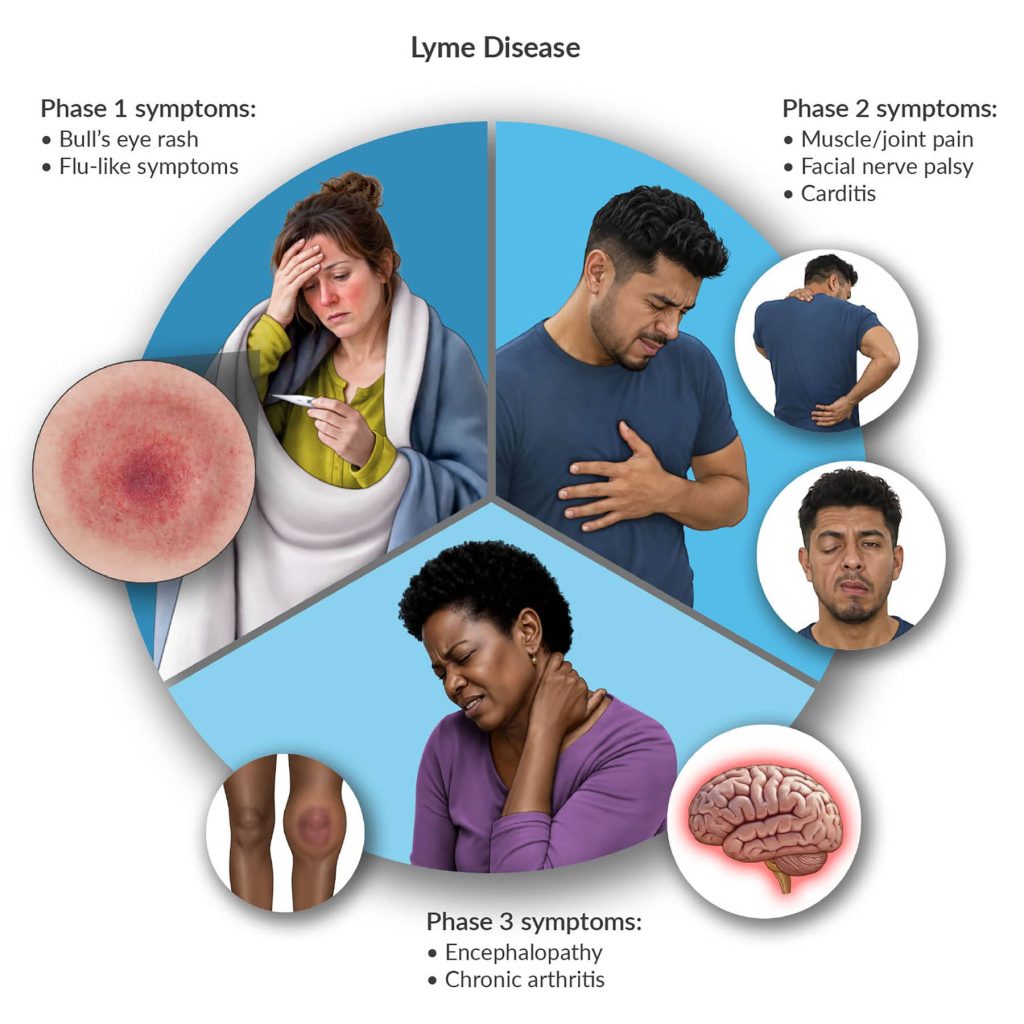
Despite Lyme disease being considered the most common vector-borne disease in our nation, in the 51 years since it was first reported, incredibly little progress has been made in its diagnosis, treatment, and prevention. Treatment today usually involves a short course of one of several antibiotics (e.g., doxycycline, cefuroxime), often administered empirically, because current antibody-based tests can easily miss early infections. And sadly, antibiotic therapy is not always effective, and if started too late, chronic Lyme disease, even forms known as neurologic Lyme disease, Lyme-cardiac involvement, and Lyme-arthritis can make treatment challenging.
Really? After 51 years, little has changed, and it seems, from our perspective, that early detection and prevention have not kept pace with advances in other infectious disease domains. Are we being too critical? We think not, but hear us out.
What’s happening on the diagnostic front?
With so many cases domestically as well as in Europe, where Lyme disease is common, with more than 200,000 cases treated each year, diagnosing the disease early is key to getting effective treatment underway. You’ve probably heard that classic sign of the tick bite causing Lyme disease is a bull’s-eye rash, but that does not happen in all who are afflicted. Then there are the general flu-like symptoms, which can vary like the wind, may not be attributed to a tick bite, and may prove more obfuscating than anything else. And the standard clinical lab study involves serologic tests that assess an antibody response, which may take as long as 6 weeks to develop. For long-standing Lyme disease, Lyme arthritis, and other manifestations, the serology approach is reliable, but the early window of infection is often missed.
Let’s elaborate just a bit on the lost opportunity of an early diagnosis. There is now yet another syndrome appearing in the literature: “posttreatment Lyme disease syndrome (PTLDS).” This is a persistence or recurrence of symptoms that may eventually lead to chronic musculoskeletal pain, physical infirmity, and even cognitive and behavioral complaints. The single greatest risk factor for PTLDS is delayed initial treatment.
But the good news is that work is moving forward beyond just antibody testing using emerging technologies. One example is the LymeX Diagnostics Prize, a federal government/private enterprise hybrid whose goal is to speed the development of new testing approaches. To date, over $ 3 million has been awarded. Likewise, the NIH is funding studies involving victims known to be in the throes of early-onset Lyme disease who might help researchers identify early biomarkers. While nothing is definitive yet, know that work is underway.
Why don’t we have a vaccine?
The intent here is not to perturb anyone who has strong anti-vaccination views, but rather simply to note that while we have vaccines for many conditions, one for Lyme disease has proven hard to pin down. But that may be changing. In 1998, LYMErix, the only vaccine that had emerged and won FDA approval, was demonstrated to be effective but was withdrawn from the market largely due to low sales and concerns of side effects; in retrospect, those were unlikely to occur. For companies that might have been interested in developing a vaccine, the disastrous, resource-intensive experience of LYMrix proved so economically disastrous that any enthusiasm for vaccine development was apparently extinguished.
The growing menace of Lyme disease has apparently urged at least two pharmaceutical companies to develop preventive approaches. Tonix Pharmaceuticals’ TNX-4800 is a human monoclonal antibody targeting the causative organism of Lyme disease that might be administered once a year in early Spring. It is hoped the protection would start within 2 days of administration and last throughout the U.S. tick season.
Pfizer’s candidate vaccine is LB6V, which has navigated at least one phase 3 trial that included those as young as 5 years old. Results were very promising, although the study was hampered by the fact that few in the control group developed Lyme disease, making it difficult to assess the vaccine’s effectiveness. If that doesn’t make much sense to you, consider a new anti-PONV drug being tested in a trial where hardly anyone in the control group experienced PONV! That said, the FDA is keeping LB6V on its radar, and the company’s website projects a very optimistic view.
As we explored further and admitted our bias toward hoping for a marketable vaccine, we were a bit discouraged to learn that 3 initial shots over a 9-month period, followed by a booster, would be required for LB6V. That might be a heavy sell to get individuals and families to accept 4 different shots. Nasal or oral vaccine delivery is fraught with challenges due to the intrinsic immune and cleaning aspects of both routes. We may discuss these issues in a future blog post, raising the question: why can’t all vaccines be needle-free?
Tick collar, anyone?
Those of you who have a dog or cat may use a chemically impregnated collar on them that wards off or kills fleas and ticks. While we might spurn the idea of wearing a collar as an anti-tick approach, what about a pill? A company, Tarsus Pharmaceuticals, is studying the drug lotilaner, which is already FDA-approved for an unrelated condition. In this scenario, a tick that locks onto you will experience an early death. Recall that a tick needs to be attached for longer than 24 hours to pose a threat as a vector of pathophysiology.
A few anesthetic considerations for the patient with Lyme disease
While there are no firm guidelines, that is, each patient should be managed on a case-by-case basis, here are some general thoughts that have been discussed in the literature:
- Arrhythmias due to atrioventricular block can be seen; bradycardia is particularly common
- Even in the young patient, obtaining a pre-op baseline ECG may be prudent
- CNS symptoms, especially in chronic states of meningitis, suggest that a neuraxial block may not be ideal
- Reports of cranial nerve palsy may affect perioperative airway integrity/protection
- Antibiotic therapy that the patient is taking should be continued
- Anticipate unusual responses from the immune system, which may be perturbed by the ongoing infection
- Consider postponing elective procedures, especially if the patient is febrile, has a concomitant systemic illness, or is unstable in any way. Allowing for Lyme disease to be fully treated may be prudent.
Feeling somewhat relieved by this research?
We can’t speak for you, but we are feeling optimistic about what is going on out there, as we know that great minds and talent, fueled by the power of private industry and our federal government, are actively seeking solutions to the “tick problem.” While we focused on Lyme disease, more than 800 tick species transmit over 100 pathogens—bacteria, viruses, even parasites. We believe that the hard-to-explain trench of productivity in solving the “tick problem” is at last being actively filled, and solutions are forthcoming.
And while that work is underway, please take precautions when “out there” and do that full-body tick check so that, if you’ve become a host, you can get it off in a timely manner. As we see in Mission: Impossible films, where Ethan Hunt disarms a bomb before the fuse goes off, removing the ticking early can prevent a whole host of problems.
We understand the challenge of finding and earning CRNA Class A credits while also maintaining a busy schedule. Whenever you’re ready, we have a course that fits what you need to meet the NBCRNA MAC program requirements.
Related Articles